
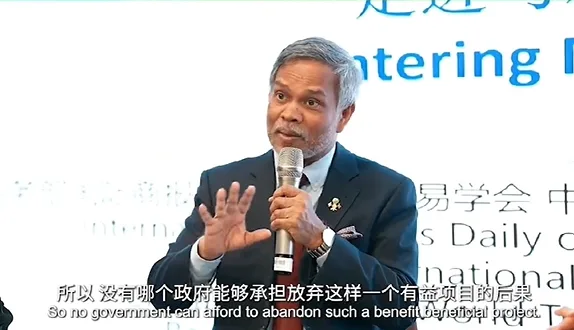
This was an in-person dialogue with H.E. Dr. Fazeel Najeeb, Ambassador of Maldives to China. I have travelled to more than thirty countries over the past decade, the Maldives among them, but this was the first time I sat down face to face with an ambassador to talk through policy continuity and the real pitfalls of landing a business on the ground. The question I had been holding for a while: the Ambassador mentioned the "New Island" reclamation project — will the policy stay stable over the next three to five years? Beyond their own national enterprises, what is the biggest challenge for foreign companies in building materials, interior, and new energy entering the Maldives?
"We do have government changes from time to time, but a large eco-island project pushed by the President like this one — land reclamation will be completed within the next five to six months. Once the island is built, everyone benefits: housing, commerce, infrastructure, hospitals, schools — all of it. Every Maldivian, including foreigners, will gain from it. No government could afford to walk away from a project that benefits everyone. The project will continue; there may be minor local adjustments, but the overall direction will hold."
— H.E. Dr. Fazeel Najeeb, Ambassador of Maldives to ChinaThe answer itself did not surprise me — the logic that a mega project survives because "it benefits too many people to stop" holds in many countries. What I wrote down was the second answer.
"The opportunities for foreign companies to participate are very large, no doubt — quite a few foreign firms are already operating in the Maldives. For companies just launching a new project, the hardest part is the 'first-step mobilization' — you have to ship in all the equipment, and build dormitories for your staff. The government will provide land and let companies put up their own worker housing; that is how Chinese companies solved accommodation, and how Japanese and other construction firms did it earlier. One thing is absolutely critical for any newcomer: local knowledge. Without it, you will run into a lot of trouble. The best approach is to hire one or two people with local experience — it will help enormously when dealing with government agencies, local suppliers, the tax authorities, and everyone else. Local knowledge, I must say, is very, very critical."
— H.E. Dr. Fazeel Najeeb, Ambassador of Maldives to ChinaThe phrase "local knowledge" comes up in business conversations across many countries, but rarely stated so plainly, with no hedging — not the polite "do get to know the local context," but "without it you will definitely run into a lot of trouble." That degree of directness is, in itself, information.
It also confirms what I have long believed: in markets like the Maldives, rather than sending in a team to fumble blindly, it is often worth far more to first plug into a network already rooted on the ground and cover the "local knowledge" lesson — more than the agency fees you might save.